Cyreenik Says
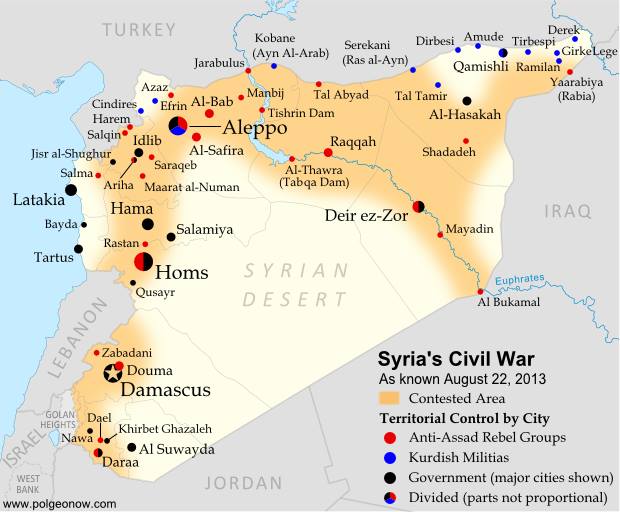
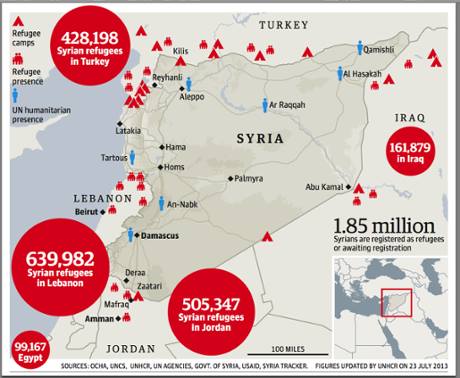
Syria is messy, and has been for two years. What's going on here is the proverbial barroom brawl. The most recent ugliness is that someone has started using gas weapons, but that is not really "crossing the line": It was ugly before and it's ugly now.
These two maps show the factions -- many -- and the refugees -- also many. What this means is that this is no "Us versus Them"/"White hats & Black Hats" situation. It's... complicated! (thanks to David Ziegelheim for locating these maps)
|
|
So... what to do?
This has become a proxy war -- many rich and influential groups surrounding Syria are providing arms and equipment to the factions that are supporting what these outsiders think is right. It's these outside weapons and money that are making this war long and vicious. I've written about this phenomenon in war making in my essay Long Wars = Surprise Enemies and Protected Resources. Syria is turning into a classic example.
And this points to how the US should get involved if it wants to have a "cool-head" response. What the US should be doing is saying to all the faction supporters, "Back off! Don't send in supplies unless you want to face us!" -- as in, working up an effective arms embargo.
This will let the fighting wind back down into low-grade conflict, and some time after that happens the participants will see the virtue of talking over fighting.
This 11 Aug 13 Washington Post article, Rival sides in Egypt prepare as police say they will besiege sit-ins backing ousted president, talks about how the unrest in Egypt has not abated with President Morsi's ouster. This is not surprising. The Egyptians and other Arabs are still sorting through their many social options, and this is what a social revolution is all about. (I wrote about the Spring previously in Nov 12, Feb 11 and Jan 11.)
The next phase, whenever it comes, will be when the powers behind the scene in Egypt get tired and frustrated with the chaos and constant changing of who's in charge and what programs the government is supporting. When this frustration gets big enough they will overcome their distaste for it and support a strong man type who will "kick butt and take names". He, it's usually a he, will be a ruthless leader who doesn't mind letting a surprising amount of blood to bring back order. He's not going to be a populist like Morsi, he's going to be more the Saddam or Khomeini type who is quite willing to let blood flow in the name of restoring order. And he's likely to have just as idiosyncratic a personal agenda as well.
The great international hazard is such a strong man will not hesitate to include cross-border bloodletting in the mix, and in the case of Egypt there is really only one likely choice for that: Israel. Most likely that bloodletting will be indecisive -- it will do little more than shed lots of blood -- think the eight year Iran-Iraq War. But once in a while you get a Napoleon in charge and the blood letting can result in spectacular military success as well -- Napoleon was the bloodletter for the French Revolution. The challenge in Egypt's circumstance is that Israel is not equipped to help Egypt shed lots of blood over many months or years. They are compelled to make any conflict decisive and fast... not what Egypt's up-and-coming ruthless leader needs.
The moral: The Arab Spring big surprises aren't finished yet.
Update: This 14 Aug 13 WSJ article, Hundreds Dead in Egypt Crackdown Security Forces' Efforts to Clear Cairo Sit-Ins Sparks Violence; At Least 278 People Killed Across Egypt by Maria Abi-Habib and Leila Elmergawi, describes the violence getting deep and widespread. The strong man may emerge soon.
This is also a departure from 21st century protesting formats because these security forces are using so much violence in spite of the massive video recording presence. This will likely go down in Egyptian history as a Tiananmen Square equivalent -- something subsequent governments will be embarrassed about. On the other hand... we have the even more massive civil war violence in Syria going on today.
Fellow MIT alum John Chisolm has written this nice 6 Aug 13 Forbes.com article, 6 Ways To Save U.S. Startups And Jobs From Death By Regulation, which offers some good suggestions for how recognize when regulations are not doing what they intended, and, instead, are being hugely expensive. The heart of the recommendations is to analyze and experiment.
Well said, John! I will add that the heart of this issue is paying attention to the right things. In these latest decades Americans seem to have become deeply distracted by many issues, such as various rights, that are expensive to pursue and kill growth when they are backed up with regulatory teeth. We need to become aware of the full expense of these distractions. John's recommendations at the end of the article will help on this issue.
This thought is inspired by a 3 Aug 13 lead article in The Economist, Security v freedom in the United States: Liberty’s lost decade, which reviews the abuses to freedom in the name of security that have been inspired by The Great 9-11 Fear. This starts with Guantanamo and the Patriot Act and rolls up to the Manning trial and the Snowden revelations of today, more than a decade later. It's a sorry list. I've been railing against each of these security-over-freedom choices as I found out about them, and I haven't changed my mind. These are corrosive, cancerous choices.
One difference between the Economist view and mine: Economist blames the Bush and Obama administrations. I blame the American people and media. They got just as terrified as the government when 9-11 happened, and they have been consistently supporting these choices ever since.
We Americans need to teach ourselves that being secret and violent about how we fight terror is terrorism itself. The much better alternative is to build enfranchisement by building rule of law and transparency. Here's my latest motto, this one inspired by Thomas Jefferson's quote, "The tree of liberty must be refreshed from time to time with the blood of patriots and tyrants." Roger's Liberty Truism, "We must not allow the tree of liberty to be choked out by the weed of security."
This thought was inspired by a 27 Jul 13 Economist article, Zoning laws: Biking and hiking, but no parking, which talks about the impact Oregon's comprehensive zoning laws are having on the state's growth. From the article:
"THE city of Vancouver, Washington lies just across the Columbia river from Portland, Oregon. Since 1990 Portland’s population has grown by 38%, while Vancouver’s has nearly quadrupled. To critics, that is proof that Oregon’s strict land-use laws are crimping the city and the state’s growth. To supporters, it is a sign that the planning regime is working as intended, preventing sprawl and preserving Portland’s pristine surroundings—on Oregon’s side of the river, at any rate."
This is the route the big cities of the Midwest walked down in the 1950's and 60's. This is a repeat of the Prescriptive Experiment. We will get to see if Oregon's fate comes out differently. If Oregon thrives, then its time for me to look for a new hypothesis. ...But I'm not in a hurry.
-- The End --